Posts Tagged ‘bird canada’


Finches of the Boreal Forest

Wednesday, November 16th, 2011

No, unfortunately I haven’t been travelling to the boreal forest. This is a guest post from Janet Plante, who lives in the boreal and will be writing monthly blog posts for Bird Canada. Some of the birds she regularly gets on her property throughout the year will make southern bird watchers drool.

We live in a rural area in northwestern Alberta. To the north within a mile or two is a river valley and to the south as far as a bird can fly is boreal forest with very little if any civilization. In fact, if you flew far enough to the west you would end up in the Rocky Mountains.

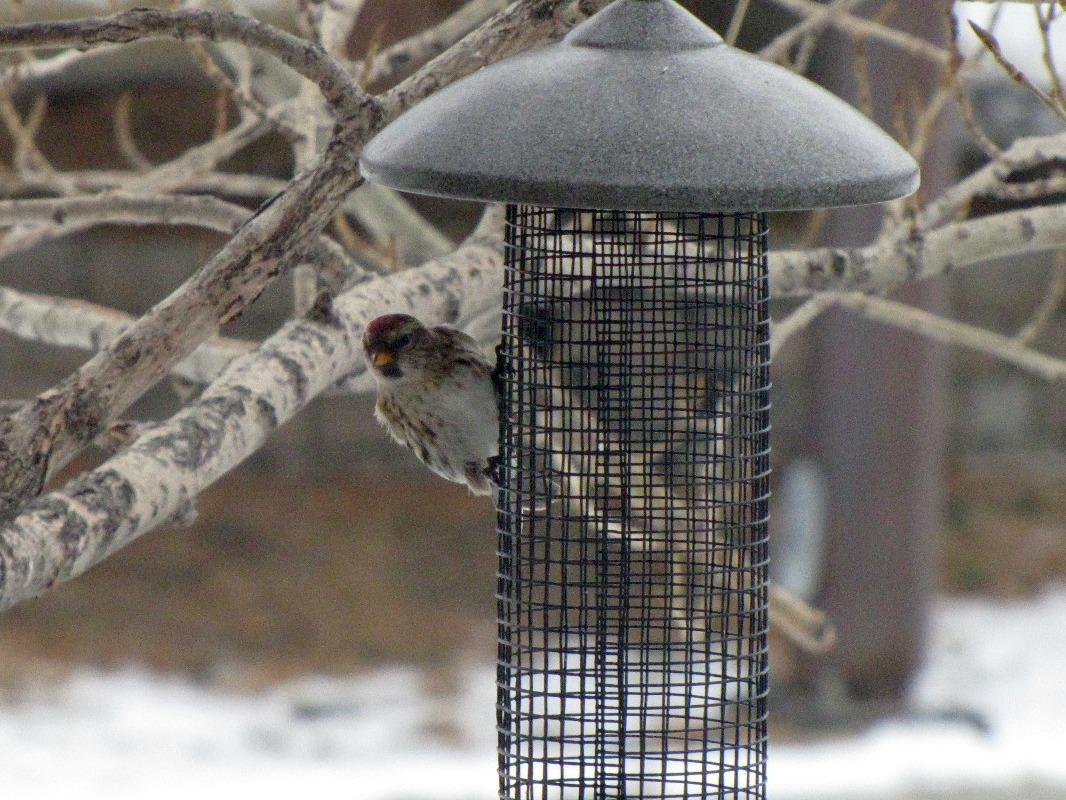
All year we are entertained by chickadees, woodpeckers, blue jays and nuthatches and for the last year or so we have been blessed with a very large finch family. From the eating frenzy in the winter of the Pine Siskens and Common Redpolls to the occasional and very welcome visits of the Pine Grosbeak we marvel at these colorful birds.

This past summer a flock of Evening Grosbeaks took up residence and we were able to watch the family grow throughout the summer. Observing papa feed a young one almost as big as himself was a real treat.

While the presence of a a Blue Jay would send all of the birds scattering, the Evening Grosbeaks didn’t seem to mind sharing the food and location with their finch cousins, the Purple Finches and the Pine Siskins.

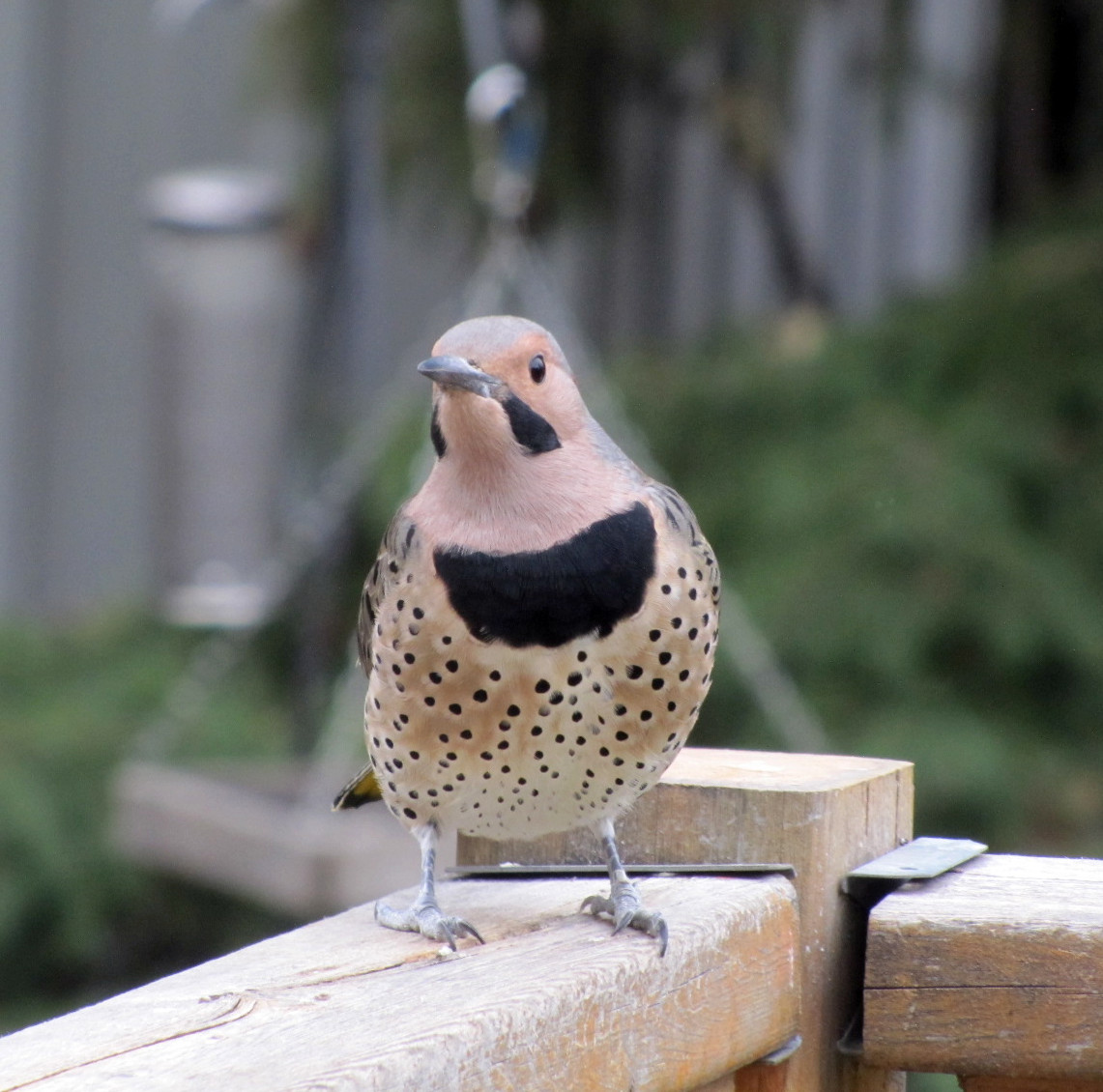
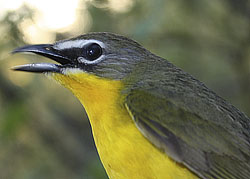
And sometimes we get even more colourful visitors!

Project Feeder Watch 2011

Thursday, November 3rd, 2011

Backyard birdwatchers across Canada are invited to take part in the 25th season of Project FeederWatch, from November 12 through April 6. With each season, FeederWatch increases in importance as a unique and indispensable monitoring tool for more than 100 bird species that winter in North America. Last year, over 2,500 Canadians and 11,000 Americans counted backyard birds; their observations help scientists better understand the health and behavior of birds – an important indicator species for the well being of our planet.

White-breasted nuthatch at the suet feeder

Each checklist submitted by ‘FeederWatchers’ helps scientists at Bird Studies Canada and the Cornell Lab of Ornithology learn more about where birds are, how they are doing, and how to protect them. Participating in Project FeederWatch is a great way for families and friends to connect with nature, have fun, and help birds. You do not have to be an expert to participate – they’ll send you a poster of common birds, and help is just a phone call or email away.

Participants choose how much time they want to dedicate to the project. They are asked to select their own two-day count period once every two weeks, and then count for as little as 15 minutes (or as long as they like) on one or both of those days. Sightings are entered online at www.birdscanada.org/volunteer/pfw or reported on paper data forms and mailed in at the end of the season.

Data from FeederWatchers have helped scientists learn about changes in the distribution and abundance of feeder birds over time, expansions and contractions in their winter ranges, the spread of disease in bird populations, and the kinds of habitats and foods that attract birds.

Sign up for Project FeederWatch here

Source: Bird Studies Canada  

Whooping Crane Wednesday

Wednesday, October 12th, 2011

Last weekend, a small group of local birders were lucky enough to meet North America’s tallest birds in person.

Whooping cranes stand about 1.5 m (5 ft) tall. Their wingspan is 2 m (6.5 ft) or more between the tips of their long black flight feathers. At close range, adult whoopers are imposing birds, with snowy-white plumage, black bristle-like feathers on crown and face, a small black patch on the back of the head below the crimson crown, and bright yellow eyes. They get their name from a distinctive whooping call that carries over several kilometres.

Whooping crane range map courtesy Canadian Wildlife Service

The creation of Wood Buffalo National Park near the border of Alberta and the Northwest Territories has undoubtedly helped to prevent their extinction. When the park was established in 1922 to protect the wood bison herd, it was not known whooping cranes nested there. Today this park is the only place where a self-sustaining population of wild whooping cranes exists.

The flock winters in Texas, where it occupies about 90 km2 along the coast. The United States government designated this area as the Aransas National Wildlife Refuge in 1937, partly to preserve suitable wintering habitat for the whooping crane.

Captive breeding and reintroduction has played an important role in the recovery of the whoopers. Since 1993, the Devonian Wildlife Conservation Centre (DWCC) south of Calgary has been breeding these big birds in captivity. Owned by the Calgary Zoo, this facility is not open to the public but they occasionally allow tours through the local naturalist club.

The DWCC covers a half section of land in the foothills. Along with the whooping cranes, they breed other critically endangered animals such as the Vancouver Island marmot, Mongolian wild horses and woodland caribou. (More on these next week).

The whooping crane enclosures are isolated from the other animals, and surrounded by an electric fence.

To keep coyotes from digging their way to these highly endangered birds, wire has been buried to a depth of four feet.

The DWCC currently houses about 20 whooping cranes. As we walked down the road towards their enclosures, we could hear loud alarm cries echoing from bird to bird announcing something unusual in their world.

Photo by Peter Cromer


The centre also houses 10 sandhill cranes that help incubate whooping crane eggs. One of the sandhills was rather obvious about what he thought of the intruders. Meet Doofus.

There was also a female and juvenile sandhill in this enclosure, but there was no way Doofus was allowing anyone to get close enough to the fence to get their picture. That bill makes a formidable weapon.

The breeding population of whooping cranes in Wood Buffalo National Park is now on the move to their wintering grounds in Texas. If you would like a chance to see these magnificent birds in the wild, you need to get yourself to Saskatchewan.

Whoopers don’t migrate in large flocks like sandhill cranes. They trickle out of their breeding grounds in family units, and in small groups of sub-adults and non-breeders. One of the best sites for spotting them in Canada is Last Mountain Lake National Wildlife Area, the oldest bird sanctuary in North America, located about an hour and a half northwest of Regina.

Anyone lucky enough to spot one of these birds is asked to report it by phoning the Whooping Crane Hotline at 306-975-5595.

I count myself amazingly fortunate to have seen these glorious birds in the wild, as I grew up in northern Alberta. Twice a year, we were privileged to hear their haunting whoops as small groups flew over the house. It is one my most enduring childhood memories.

See also:

Operation Migration

Whooping Cranes Heading South

Calgary Zoo Whooping Cranes

Last Mountain Lake Bird Sanctuary

Tracking Sable Island Gulls

Thursday, October 6th, 2011

In the spring of 2011, an Acadia University research team led by Dr. Phil Taylor, Bird Studies Canada Chair in Ornithology, captured Great Black-backed and Herring Gulls during the breeding season to fit them with electronic tags and mark them with coloured wing and leg bands. The purpose is to study how gulls interact with offshore platforms and vessels, and to learn more about the year-round movements of these birds.

Tagged Herring Gull in flight. Photo by Robert Ronconi

This research relies on reports of banded birds spotted by birdwatchers, beach goers, offshore workers, fishers, and keen observers anywhere. Sightings throughout the year will help researchers to map out the home range and migration routes of Sable Island gulls. Sable Island is currently designated as a Migratory Bird Sanctuary, an Important Bird Area, and is slotted to become Canada’s newest national park in the near future.

You can learn more about this research on the Sable Island Gulls blog. To report your sightings of marked gulls, email robert.ronconi@acadiau.ca. Photos are welcome!

This research is supported by Encana Corporation and by Environment Canada’s Canadian Wildlife Service. Encana is the owner and operator of the Deep Panuke offshore natural gas project located 250 kilometres southeast of Halifax, Nova Scotia on the Scotian Shelf.

Source: Bird Studies Canada 

Aiming For The Wallets

Tuesday, September 27th, 2011

Alberta’s disappearing sage grouse continue to make the headlines. Billboard campaigns are revving up, and more people are paying attention. A lot of people are at the wringing of hands stage, saying but what can we do?

Based on past experience, it’s obvious we can’t rely on either the federal or provincial government to save our wildlife and wild places. It’s time for a new tactic, and it seems to me the best idea is to go for the wallets.

A great editorial in The Edmonton Journal this week has pointed out a few key facts.

Alberta cannot afford to offer environmentalists and celebrities another opportunity to give our province a black eye in front of the entire world.

But black eyes are exactly what we’ll get if we continue to spend millions of dollars killing wolves to save caribou and transplanting grouse from Montana that don’t stand a chance of reproducing in a region where indigenous birds are too stressed out to mate.

Pictures of oil-soaked ducks pulled from oilsands tailings ponds were one thing, but imagine if Greenpeace caught biologists on camera chasing down and killing a pack of wolves or sage grouse dancing nervously in front of a gas well.

With our world renowned national parks bringing in thousands of tourists and their money each year, do we really want to turn them away from Alberta? Faced with growing opposition to the Keystone Oil Pipeline, politicians and the energy industry should be pulling out all the stops if they want the revenue from that pipeline.

The energy industry in Alberta is currently waging a public relations war to improve their image. It’s time for them to step up and provide something besides rhetoric. Something concrete and sustainable, like saving grassland habitat and actively working for wildlife protection.

The Edmonton Journal editorial 

Now I’ve Got You. Oops.

Wednesday, August 24th, 2011

We’re into the dull birding month in my yard – I have house sparrows and more house sparrows, as the hatch year juveniles are now flying with the adults. House finches, mourning doves and black-capped chickadees make the occasional appearance, but it’s basically sparrow-world out there.

A couple of days ago, I was enjoying a beautiful quiet evening on the back deck, wondering where all my birds were. Suddenly I heard a different bird sound and whipped my head to the right, just in time to see a brown bird of prey land in the neighbor’s pine tree.

Racing into the the house to grab my camera, I thought at long last, I’m going to get that decent merlin picture I’ve been chasing.

I only manged to take a few photos before he flew off. Imagine my surprise when I uploaded these to the computer.

If I’m not mistaken, this is a young Cooper’s Hawk. Yes? No? Let me know what you think. The Cooper’s/Sharpie conundrum is not one I’ve solved with any degree of certainty…

I never noticed this on before, but from this angle he looks like he`s got eyes in the back of his head.

Apparently, I’m not only putting out food for the small birds, I’m contributing to the upward food chain by feeding merlins and hawks. Cool.

And not that I’m complaining or anything, but I still don’t have a merlin picture…