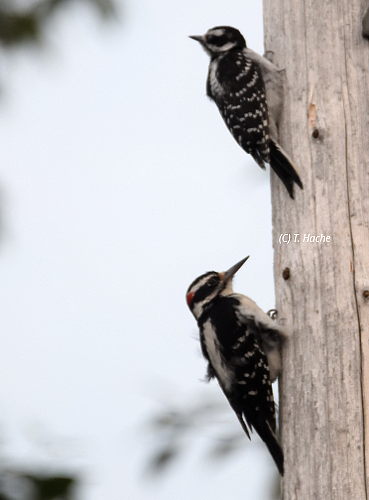
Why I Fill My Birdbath 3 Times A Day

IMG_2988a

IMG_2992a IMG_2993a IMG_2994a IMG_2996a IMG_2998a IMG_2999a

IMG_2991a

Posted in Bird Canada | 2 Comments

Boreal Biodiversity

The term “biodiversity” appears frequently in journals and popular media. In most cases, it is used to describe the number of species in a region. Scientists now realize that it also includes things like the intactness of the entire ecoysystem, large scale migration, predator-prey dynamics, genetic variability of species and local adaptations.

Previous conservation programs have been overly focused on the number of species in an area, an approach which favours tropical forests with their higher number of species packed into a smaller area.

Boreal chickadee by Dan Arndt


Boreal chickadee by Dan Arndt

With the new definition of biodiversity, northern forests such as Canada’s boreal gain substantial prominence in the conservation of hundreds of species – even more so when including the effects of climate change.

The Boreal Songbird Initiative and Ducks Unlimited have just released a 20 page bulletin entitled 10 Cool Canadian Biodiversity Hotspots. The report highlights ten locations throughout our boreal forest that provide more detail and insight into its special biodiversity and conservation values.

Biodiversity and The Boreal Forest

  • More than 25% of the world’s never-before harvested forest lies within Canada’s boreal, including at least seven of the world’s top ten largest blocks of unfragmented forest.
  • Canada’s boreal encompasses millions of lakes and ponds and in fact holds more surface freshwater than any other place on Earth.
  • Four of the world’s top ten largest lakes are found in our boreal, including Great Bear Lake—arguably the world’s largest pristine lake.
  • The boreal forest is rich in free-flowing, undammed rivers—more than there are remaining in the rest of North America combined. While river biodiversity is imperiled by dams, pollution, and over-use in most of the world, those in Canada are among the last strongholds for migratory fish populations.
  • Canada’s boreal forest is estimated to hold more than 208 billion tonnes of carbon in its trees, soils, peatland and under permafrost – equivalent to 300 years worth of our country’s annual greenhouse gas emissions at 2010 levels.

As climate change continues to impact the planet, Canada’s boreal forest becomes even more critical to protect. It will become increasingly important as a refuge for species forced northward by inhospitable climates farther south.

The best insurance for maintaining the resilience of plant and animal communities to climate change will be the preservation of intact, interconnected ecosystems and robust populations. Species that must shift ranges northward to survive will have their best opportunity to so do when unimpeded by fragmented habitat full of human-made barriers.

Bird Canada will be featuring each of the 10 amazing locations from the report in a series of blog posts during the coming weeks. More than 300 bird species occur regularly in the boreal forest. Breeding season brings the total up to an estimated 1-3 billion. When adults and young begin their fall migration, the number of birds relying on the boreal reaches 3-5 billion. Many species are highly specialized in their habitat choices, and rely exclusively on intact forest.

map-coolspots

Careful land-use planning now, that conserves large parts of Canada’s boreal forest, is imperative to provide the best likelihood of survival for countless species and preservation of the boreal’s diverse ecology.

The full report 10 Cool Canadian Biodiversity Hotspots

Posted in Bird Canada, Bird Conservation Canada, Boreal Forest Birds | Tagged , , | 1 Comment

The Hazards of Nestcamming

A few weeks ago a fellow Gabriola birder confided that some days he wished he didn’t have a nest cam. At first I assumed he was referring to the amount of time he spends watching the screen. (I could relate to that.) But it turned out he wasn’t at all concerned about the nest cam’s addictive nature. He was, instead, embarrassed that he was privy to all kinds of avian hanky-panky, some of it, apparently, rather aggressive. (I will spare you the details, some of which were definitely not appropriate for the grocery store aisle in which we were chatting.) But I’d much rather watch that (I’d try to retain a scientific curiosity) than to be subject to watching the death, over a period of many days, of all the violet-green swallows inside my nest box. That’s what happened a few years ago.

Violet-green Swallows check out nestcam box

Violet-green Swallows check out nestcam box

It all started when the mother swallow flew into the nest box one evening and, rather than feed the chicks, she lay against the side of the box. She’d never done anything like that before. For hours the only activity in the nest box was hungry babies gaping and peeping for food. The mother just lay there, sometimes moving her head to preen, but not much else. Within 24 hours she was absolutely still. The babies continued peeping. It took a while before I let it sink in – she was dead.

I was in shock. But, as with any death, there were immediate practical tasks to take care of. The problem was that I didn’t have a clue how to proceed. Should I remove her dead body from the nest? (I was worried about decomposition and the bugs that would appear to feast on her corpse.) Or should I leave it, so as not to disturb the babies? I called every organization I could think of for help. No one had any definitive advice. Most explained that it depended on what happened next. I was advised to watch and see if the male began to feed the babies.

I watched, obsessively. It was just after noon when he arrived – with food! Jubilant, I began cheering him on and talking up the stunning qualities of fathers to friends and neighbours who just raised their eyebrows. Unfortunately, my happiness was short-lived. Over the next week, in spite of the efforts of the father swallow, one by one, all three babies died. After the second one died, I stopped watching and coerced my husband into checking the screen every hour or so and reporting in with a simple thumbs-up or a thumbs-down. Words were too painful. Actually, it’s still too hard to write in any detail about that heartbreaking week.

Eventually I called the folks at the BC Interagency Wild Bird Mortality Investigation Protocol (BCIWBMIP) to try and find out what had happened. At that point, after lots of research, I could only come up with two possible scenarios. One: the mother was a healthy bird that had barely escaped a predator, made it back to the nest, then died of a heart attack brought on by the stress of the incident. Or two: the mother contracted an illness and passed it on to the babies. Neither of these possibilities fit well with the sad events that had occurred.

The woman I spoke to couldn’t give me a definitive answer, and said it was too late to find out for sure. Then she walked me through what could have happened IF I had called them earlier, just after the mother died. I thought I should share this with you – although I hope you’re never in this position. I am assuming that all province’s have their own version of the BC Interagency Wild Bird Mortality Investigation Protocol.

WHEN A BIRD DIES

I learned – too late – that I could have found out what caused the deaths IF I HAD DONE THE FOLLOWING.

• Remove the mother swallow’s body from the nest, within 12 hours of her death, using gloves and taking sanitary precautions – but only if I could do so without disturbing the babies too much. (I’m still not sure how I would have predicated or accomplished that.)

• Store the corpse in a double plastic bag labelled with date of death, location, and species.

• Keep the body cool until instructed where to send it by BCIWBMIP

• Call BCIWBMIP at 1-866-431-BIRD

THREE DEAD BIRDS?

BCIWBMIP is also interested in knowing if you discover three or more dead birds within the same location, or dead waterfowl, shorebirds, eagles, hawks, or owls.

DEFORMED BEAKS/BILLS?

The US Geological Survey at The Alaska Science centre asks that you report any bird with a beak deformity (dead or alive) to them by filling out the form at: http://alaska.usgs.gov/science/biology/landbirds/beak_deformity/observerreport.html.

Okay, enough of death! I promise something less depressing next month!!

Posted in Bird Behaviour, Bird Canada | Tagged , | 2 Comments

Cypress Hills Interprovincial Park

May long weekend camping has, as for so many families, become a tradition for us.  Living in a “two season” province, this annual ritual feels in many ways like the start of summer and it’s nicely timed for some spring migrant birding.  This year procrastination on the booking shut us out of our usual destination of Kinbrook Island Provinical Park, south of Brooks, and we headed farther afield to the Cypress Hills Inter-Provincial Park, which straddles the Alberta/Saskatchewan border about 40 km south of the Trans-Canada Highway.

Conglomerate Cliffs in Saskatchewan West Block of Cypress Hills, looking north.


Conglomerate Cliffs in Saskatchewan West Block of Cypress Hills, looking north.

The biogeography of the Cypress Hills is unique due to a quirk of its geological history.  During the last glaciation of Alberta, these hills were the only feature east of the Rocky Mountains not covered by ice, sticking out above the icefield as a nunatak.  The hills would have been a glacial refugium for a variety of flora and fauna, while at the same time being physically shaped by the icesheet around them.  Today, these hills stick out as an island of forest above the surrounding grassland, still a refuge of sorts for rare plant species and, of course, migratory birds.

Fort Walsh National Historic Site. A test of your birding obsession: does this photo make you think a) hey look, a fort, or hey look, a bunch of really birdy mixed habitat?


Fort Walsh National Historic Site. A test of your birding obsession: does this photo make you think
a) hey look, a fort, or hey look, a bunch of really birdy mixed habitat?

In planning our trip we headed to the Saskatchewan side, because my wife said it was “better” – she grew up in Regina so who am I to argue!  The park is in practice divided into two sections, west and centre, with the larger west block straddling the border.  The Saskatchewan Centre Block is developed with campgrounds, cabins, and low-key resorts while the Saskatchewan side of the Western Block, which borders on the federally maintained Fort Walsh National Historic site (above), is left essentially as wilderness.  As can be seen in the two images above, both zones have extremely varied habitat – prairie grasslands and ranches surround the parks, with aspen forest on the slopes and dense lodgepole forests on the top of the plateau broken up by patches of fescue grasslands.

Chipping Sparrow

While camping in the Centre Block, I spent some time exploring the surrounding forest and trails, finding Hairy Woodpecker feeding on deadfall and Yellow-bellied Sapsucker on healthier trunks above.  An American Robin was nesting above a neighbouring site, hopefully not too freaked out by the late-night partiers that had occupied it for the weekend.  Robins aside, the three dominant songbirds on my visit were Chipping Sparrows (above), which were everywhere, Pine Siskins, with a flock of over a hundred hanging around a backyard feeder, and the pink-sided subspecies of Dark-eyed Junco (below).  If you are a compulsive lister, this last bird is an excellent reason to take the detour to Cypress Hills as they are widespread and this is one of only a few places in Canada to find this subspecies.

"Pink-sided" Dark-eyed Junco

We also took a drive across the rough Gap Road to visit Fort Walsh and the West Block.  Fort Walsh was both interesting and “birdy” with Mountain Bluebirds and Violet-green Swallows (below) feasting on the year’s first crop of bugs.

Violet-Green Swallows

This route also provides the opportunity to find wetland species as the stretch of grassland between the two blocks of the park is dotted with little ponds, each with its own family or two of waterfowl.  Observed nesting species included Wilson’s Phalarope, several species of duck, and Willet, including one that was aerobatically mobbing a hunting Northern Harrier.  This trip was also the first time I have seen the floating nest of Red-necked Grebes up close, although this pair was unfortunately trying to start a family on the main lake in the park beset on all sides by canoes and paddleboats.

Red-necked Grebe

After a very enjoyable weekend in the park we headed back across the southern-most part of Alberta and Saskatchewan, checking out Pakowki Lake and other wetlands along the way, finding Eared Grebes, Black-necked Stilt, and Cinnamon Teal, and a host of grassland species such as Chestnut-collared Longspur, Lark Bunting, and Ferruginous Hawk.  Cypress Hills is certainly well worth the drive, either as a detour from a trans-Canada road trip, or for a weekend away from Calgary.  Lots of information about the park, including a bird checklist, can be found at www.cypresshills.com.  My ebird checklists for the weekend of very casual birding are as follows: roads around Cypress Hills/Maple Creek area, Centre Block, Gap Road, West Block, and Fort Walsh.

Posted in Birding Trips, Canadian Birds, Grasslands Birds, Nature Photography, Waterfowl | Leave a comment

Owl Ambassadors

IMG_2268aHave you been following the the great Birding Is Fun blog? Thirty one birders from around the world write monthly posts, and the variety of topics and photos is truly awesome.

How I ended up sharing web space with some of the best birders and writers in the world is beyond me. :D I’m having fun with it, and no one has asked me to leave, so I guess I’ll continue.

This month I decided to write about a Great-horned owl family in Calgary who are doing their bit to educate folks about owls. Check it out at  Whoo Says It’s Too Close?


Posted in Bird Canada | 2 Comments

Finding Wilderness in Toronto

I marvel how much I learn from birds. I do not exaggerate when I say that they have taught me how to see, how to pay attention to detail, and how to appreciate the unexpected finds even when the sought after bird is nowhere to be found. In a sense, birding has forced me to slow down, and to embrace the unplanned – even if that means driving two hours to see Townsend’s Solitaire that turns out to be obscured by such intense fog that all we can see is a silhouette. What made the day memorable wasn’t finding our target bird as much as stumbling upon an unexpected flock of Evening Grosbeaks, bursting with color against the grey winter sky.

What I didn’t expect was that birding would teach me to love Toronto in a new way, and to discover its hidden (and not so hidden) patches of wilderness in the middle of urban commotion. I recently discovered the Tommy Thompson Park – often also called the Leslie Street Spit – a five-kilometer-long peninsula that juts out into Lake Ontario. The park is a brilliant surprise: a man-made park was originally designed in the 1950s as a breakwater for harbor expansion; since the 50s, it has also functioned as a dumping zone for surplus from development sites in Toronto and dredged material from the lake. The park has grown into Toronto’s best-kept secret, and most exciting stretch of wilderness, with over 300 avian species and a thriving bird research and banding station.

4788738

Tommy Thompson Park, Toronto. Photo from here.

All sorts of birds nest in the park, including 6 percent of the world’s breeding population of ring-billed gulls. That translates to roughly 30,000 pairs. In winter and early spring, you can see the awe-inspiring Hitchcockian-looking cormorant nests on the bare trees. And in May, the park warbles with Spring migrants passing through on their way to breed in the north.

This Spring, I signed up to volunteer at the Tommy Thompson Park Bird Research Station (TTPBRS) on Saturday mornings, and have learned to look forward to the 4am wake-up call. There’s nothing like setting up mist nets while watching the sun rise over Toronto, slowly illuminating every detail of a city you thought you knew so well. The real treat, of course, has been the opportunity to examine up-close birds I’ve seen from a distance and read about in field guides. The biggest surprise, for me, has been discovering that there really is no such thing as a boring bird. Even the Warbling Vireo – which I always considered drab, grey, monochrome, and nondescript on the best of days – has turned out to have a delicate white line above the eye, as if the bird meticulously applied makeup for a theatre performance.

The female birds have been a true revelation. I’d always considered them a drab disappointment compared to their male counterparts. But then, I saw a female American Redstart up-close and couldn’t believe how much the bird’s khaki and delicately pale yellow resembled the color-scheme worn by the classiest JCrew models. The female Black-Throated Blue had an understated elegance, including a seductive white spot on her back and a silky yellow line above the eye, offset by the remnants of a brilliant white eye-ring.

And the best part? All of this avian greatness and wilderness feels like you’re worlds away from a traffic-filled, noisy metropolis, and yet it’s only 10-minute drive from downtown.

Posted in Bird Behaviour, Bird Canada, Birding Trips, Canadian Birds, Nature News, Songbirds, Wood Warblers | Tagged , , , | Leave a comment

Practice makes perfect

Sometimes I get asked how I was able to identify a certain bird, or how I knew what I was looking at. Heck, a lot of the time I ask myself how I’m supposed to identify many species. While there is no real one way to become a better birder, the age-old saying ‘practice makes perfect’ can certainly apply.

For me, this means spending a lot of time studying various field guides. I get to know my local species well by spending about ten minutes every morning looking at my field guide.  Ten minutes every morning before school or before work, just while eating breakfast, that’s all it takes. A little while after I started this, I found myself identifying birds more easily because I knew what I was looking for. And once you know what to look for, the tricky species won’t be nearly as tricky!

Clay-colored Sparrow

For example in this photo of a Clay-colored Sparrow we can see the two light-colored arcs above and below the eye and a dark eyeline. Once we know to look for these, identifying a Clay-colored Sparrow will be somewhat easier. Though, mind you, it’s not quite as simple as that! We can always confuse species with one another but like I have said, knowing your locals really helps, and once you’ve spent some time with your field guide, you then need to spend some time in the field; practice makes perfect! See if reading a field guide while you eat breakfast every morning helps with your identification skills!


Posted in Bird Identification | Tagged , , , | Leave a comment

Evening Grosbeak

Posted by Cindy Boucher

Evening_Grosbeak1_b

Evening Grosbeak

sprucebw

Spruce Budworm:  Moth and Larvae Stage

“Everything we do affects something else.”

This statement stayed with me in a recent conversation about the Evening Grosbeak presence in New Brunswick during the 70 & 80’s.  Let me explain.

During those years people recalled incredible numbers of Evening Grosbeak populations in the woods.    So many in fact, that car accidents were said to have occurred due to the large numbers that gathered on the roads in search of road salt and grit.  The “word” on the street was that these birds had been brought into New Brunswick to help combat the Spruce Budworm epidemic.  Now this caught my attention.  My warped sense of humor envisioned harried truck drivers transporting hundreds of protesting Grosbeaks to the province.  Somehow, this didn’t add up.  So, this prompted some research into the topic.

Evening Grosbeaks mainly eat Spruce Budworms during breeding and nesting season.  It would make sense that this migratory species would make their way east for the insects that were so plentiful during the years of the outbreak.  Since each Grosbeak can eat around 1000 budworms/day I can only surmise that huge flocks could decrease numbers by a fair amount.  While this number sounds large, New Brunswick was dealing with a serious infestation and the wood industry was feeling the effects.   Their solution was to spray and cut the wood in hopes of avoiding catastrophic losses.

After the spray program, numbers declined sharply in the Evening Grosbeak population.  Rumors have it that hundreds of these birds were found dead in these hot zones.  Yes, we know these birds are an irruptive species but the reality is that a serious look on the internet reveals a common truth:  these birds have decreased in population and we don’t really know what happened.   Whether this is a natural occurrence or they became casualties to the spray program it is important to understand why and what can be done to avoid future losses like this one.  Remember my opening remark, “Everything we do affects something else”.  Well, here was a clear case of the birds doing what they do naturally and as a result were decreasing the budworm population when human intervention steps in to save the industry.   Now, this is not to slam anyone, this is about opening up to other solutions to reduce the impact on both species and environment.  Since most of us use paper products of some sort what could be considered to prevent the needless death of so many birds but also keep the industry alive?  There has to be a healthier solution.

After reading pages and pages of information I wonder if another way to approach this issue would be to not plant monoculture forests and plant multi-species plantations instead.  Since the Spruce Budworms become out of control where single species are grown, maybe we could switch to multi -species and let the Evening Grosbeaks and Mother Nature work on the rest thus keeping human intervention at a minimum?  Observations suggest that when varied plantations are created the numbers of Spruce Budworm remain manageable.  Perhaps this would be a direction worth researching further.  Tangent to this, an interesting comment that was made to me today regarding just this topic.  A senior member of the community shared, back in the 80’s, that if they continued to plant one stand of anything they would eventually upset the scales thus creating major problems for industry later as issues would surface.    Would appear he was correct as New Brunswick is forecasting another infestation of Spruce Budworm within 10 years.  Let’s hope there have been better solutions discovered.

I look forward to hearing your comments, opinions and research on this topic.  If any of you have more information I would be very interested in learning more.


Posted in Bird Canada | 6 Comments

Reifel Bird Sanctuary

I’ve lived in British Columbia my whole life and last month I finally had the opportunity to visit the Reifel Migratory Bird Sanctuary. Thanks to my birding partner Ken Kennedy, it was a dream come true. With in minutes of arrival I had Sandhill Cranes (a lifer to boot!), Canada Geese & an assortment of ducks eating out of my hand.

DSCF0022

I was in bird heaven

Before you even enter the sanctuary, there is a small building where you pay a small fee, one look from there and you are hooked. There is no turning back because there are birds everywhere you look. Perma grin set in and continued for the next few hours, so much so that cheeks hurt.

SONY DSC

The Info Centre/Gift Shop sells small bags of bird seed to feed the hungry masses for about a dollar. You hardly need seeds to get up & personal with the birds of Reifel but it certainly helps you get even closer.

DSCF0023

I was so excited to be surrounded by so many birds that I could have spent a small fortune if I sat in one place too long.

The geese were gentle and polite eaters but the Sandhill Cranes were quite aggressive and poked and prodded until I turned my attention to them.

DSCF0025

So happy!

The George C. Reifel Migratory Bird Sanctuary is on Westham Island, west of the of Ladner, in Delta, B. C., Canada.  It is nearly 300 hectares (850 acres) of managed wetlands, natural marshes and low dykes in the heart of the Fraser River Estuary. For the millions of birds seeking feeding and resting areas during their annual migrations along the Pacific Coast, the Sanctuary is ideally located. It is a place where wildlife and their habitats are protected from harm, and it lies next to miles of flat marshland and the farmland of Westham Island. Over 280 species of birds have now been recorded at the Sanctuary.

SONY DSC

American Wigeon (male and female)

SONY DSC

Sandhill Crane


I spotted at least 31 species of which 11 were ‘lifers’!

Golden-crowned Sparrow, Great Blue Heron, Mute Swan, , Canada Goose (and goslings)Wood Duck, Mallard, Gadwall, American Wigeon, Northern Pintail, Northern Shoveler,Turkey Vulture, Bald Eagle, Red-tailed Hawk, Fox Sparrow, Northern Harrier, American Coot, Sandhill Crane, Eurasian-collared, DoveShort-eared, OwlAmerican Crow, Marsh Wren, Black-capped Chickadee, EuropeanStarling, Spotted Towhee, Savannah Sparrow, Dark-eyed Junco, Red-winged Blackbird, Brown-headed Cowbird, House Finch, House Sparrow and lots of gulls and pigeons.

SONY DSC

My birding partner, Ken K.

SONY DSC

American Coot

SONY DSC

Wood Duck ( male)

SONY DSC

Wood Ducks (Female and male)

SONY DSC

Golden-crowned Sparrow (male)

SONY DSC

Northern Pintail (male)

SONY DSC

The marsh lands looking towards the ocean from the viewing tower

SONY DSC

Mallard (male) and one of the many turtles in the ponds and marshes around Reifel.

SONY DSC

Mallard (male)

SONY DSC

Momma Canada Goose and her goslings


SONY DSC

Wood Duck (male and female)

http://www.reifelbirdsanctuary.com/

9 am- 4 pm every day including holidays. The Sanctuary is closed in the evenings.

Adults- $5
Children-(2-14 yrs)- $3
Seniors (60 yrs+)- $3

Driving Directions: The Sanctuary is 13 km west of Ladner in the Municipality of Delta. west of the intersection of Highways 10 and 17. From Ladner, follow Ladner Trunk Road (Highway 10) west to 47A Avenue and on to River Road. Follow River Road westward for 3 km and cross the bridge to Westham Island. Follow the main road to where it ends in front of large black gates. The driveway to the left leads to the Sanctuary’s parking lot.

hex1

Posted in Bird Canada | 5 Comments

Sharp-tailed Dancers

Outstanding video from the Alberta Conservation Association!

YouTube Preview Image

The sharp-tailed grouse is a native game bird that makes its home in the prairies, parklands and forest openings of Alberta. For much of the year the sharp-tailed grouse is a quiet, well-camouflaged bird; however, its spring shenanigans are undoubtedly one of the most impressive spectacles in Alberta’s natural history calendar.

Sharp-tailed grouse perform spring courtship displays on communal “dancing grounds”, called leks. Here males compete for breeding opportunities by displaying their “dancing” ability to females.

Leks are found in areas with dry open ground, where dancing activity keeps the vegetation well-trampled. Leks are used over several weeks beginning in late March and are often used for years, even decades. They are an important part of sharp-tailed grouse life, and the loss of suitable lek habitat can be a limiting factor for sharp-tailed grouse in Alberta.

Don’t Cut In On a Dance

Leks are an integral part of the lifecycle of prairie grouse. Active leks should never be approached, as any disturbance to the birds may disrupt breeding activities and result in the abandonment of the lek. The locations of active and historical leks are of great interest to grouse biologists. To report a lek, contact Alberta Conservation Association (ACA).

More about ACA’s work with sharp-tailed grouse

Video by Mike Jokinen, ACA. Text adapted from “Alberta’s Sharp-tailed Grouse” by Liz Saunders.

Posted in Bird Behaviour, Bird Canada, Grasslands Birds | Tagged , , | Leave a comment