Here A Redpoll, There a Redpoll…

Monday, January 30th, 2012

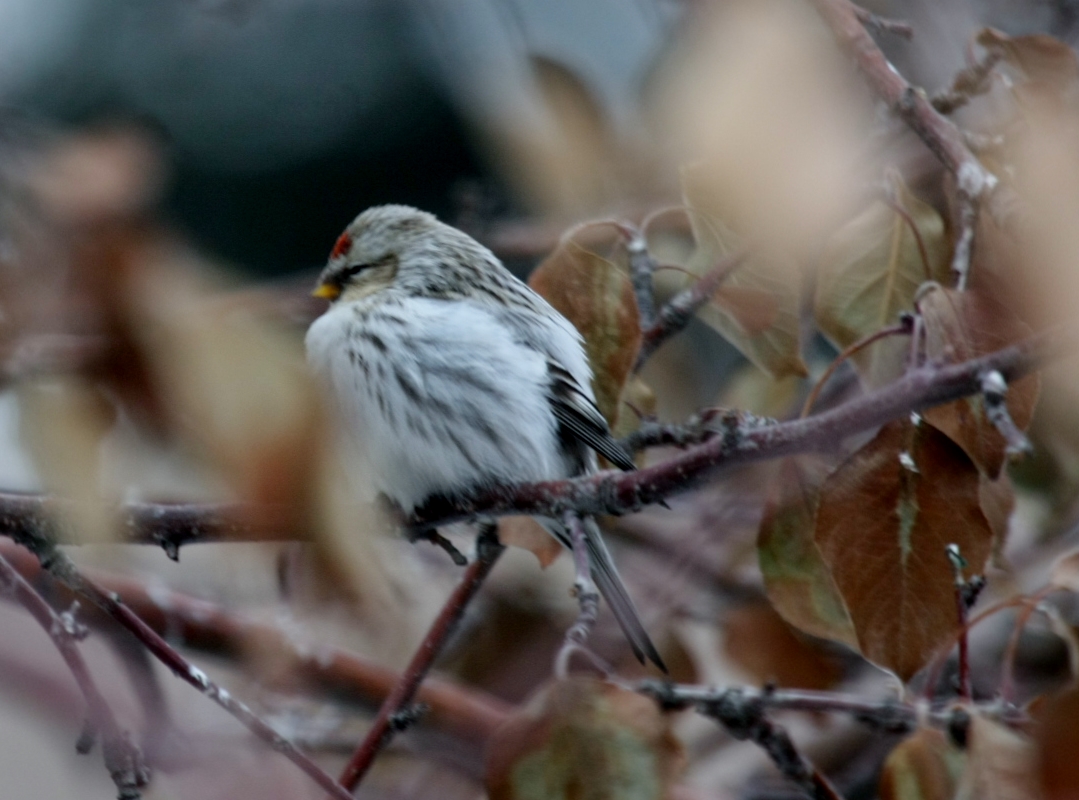
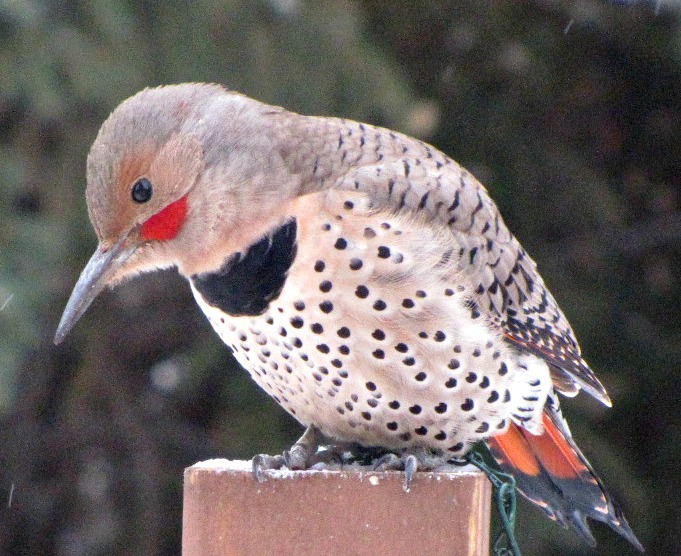
Everywhere a common redpoll. My yard has been full of these appealing little finches for the past couple of months. These small seed eaters aren’t choosy – they like niger seed, black oil sunflowers and sunflower chips. They eat at the feeders or on the ground, but I’ve never seen them at the suet feeder.

Flocks communicate with a constant twittering noise so I can always tell when they’re around. Even with all these busy little red-topped birds in the yard, I haven’t been able to definitively point to one and say “there’s a hoary redpoll.”

They are very chickadee-like in their behaviour, sometimes snatching up seeds in their throat pouches and quickly flying away to a more protected spot before swallowing them. Often feeding upside down, they can also use their feet to hold food. They are extremely quick birds, so taking a good photograph is not always easy.

Weighing just 19 grams, or about 2/3 of an ounce, it’s incredible to think these tiny birds are year round residents in Canada. In a few months, they’ll be winging their way north to the subarctic coniferous forest and scrub for the breeding season. In the meantime, I’ll just keep taking pictures and looking for hoary redpolls, which are larger, frostier, with smaller bill and less streaking. Or so I’m told.

YouTube Preview Image

Wednesday Wings: Boreal Chickadees

Wednesday, January 25th, 2012

Guest Photos by Daniel Arndt, Calgary birder and nature photographer

Dan has also written a terrific post for the Birds Calgary blog on these sweethearts of the boreal forest and many other birds that share their habitat. You can check out more of his stunning bird photography on his Flickr page too.

Read more about boreal chickadees on the Boreal Songbird Initiative Blog.

Maritimes Breeding Bird Atlas

Tuesday, January 24th, 2012

As significant results emerge from the analysis of five years of Maritimes Breeding Bird Atlas (MBBA) data, efforts have now shifted to communicating Atlas results to support conservation action. With funding from Environment Canada’s Habitat Stewardship Program (HSP) for Species at Risk, communications products are being developed for stakeholders whose land-based activities may impact species at risk habitat in the Maritimes.

The MBBA database contains the most comprehensive and up-to-date information on Maritimes birds, particularly those recently listed as Endangered, Threatened, or of Special Concern by the Committee on the Status of Endangered Wildlife in Canada (COSEWIC), such as Olive-sided Flycatcher, Rusty Blackbird, Canada Warbler, Common Nighthawk, Whip-poor-will, and Bobolink.

Distribution, and abundance maps for several declining bird species illustrate important changes in population and distribution since the first Maritimes Atlas was published in 1992. Stakeholders, including industry, municipal and rural planning commissions, as well as land trusts and nature conservancies, will now have evidence-based information to help plan their conservation strategies for species at risk habitat.

During fieldwork, Atlas volunteers focused on collecting detailed habitat information for all rare birds. The data are now being used to develop Maritimes-specific descriptions of habitats used by recently listed species. These will help with the identification and protection of critical habitat for bird species at risk, and the recovery of their populations in New Brunswick, Prince Edward Island, and Nova Scotia.

For more information on the MBBA, to order a copy, and/or if you are a stakeholder interested in Atlas data, please see the Maritimes Breeding Bird Atlas webpage.

Source: Bird Studies Canada

Snowy Owl Invasion

Wednesday, January 18th, 2012

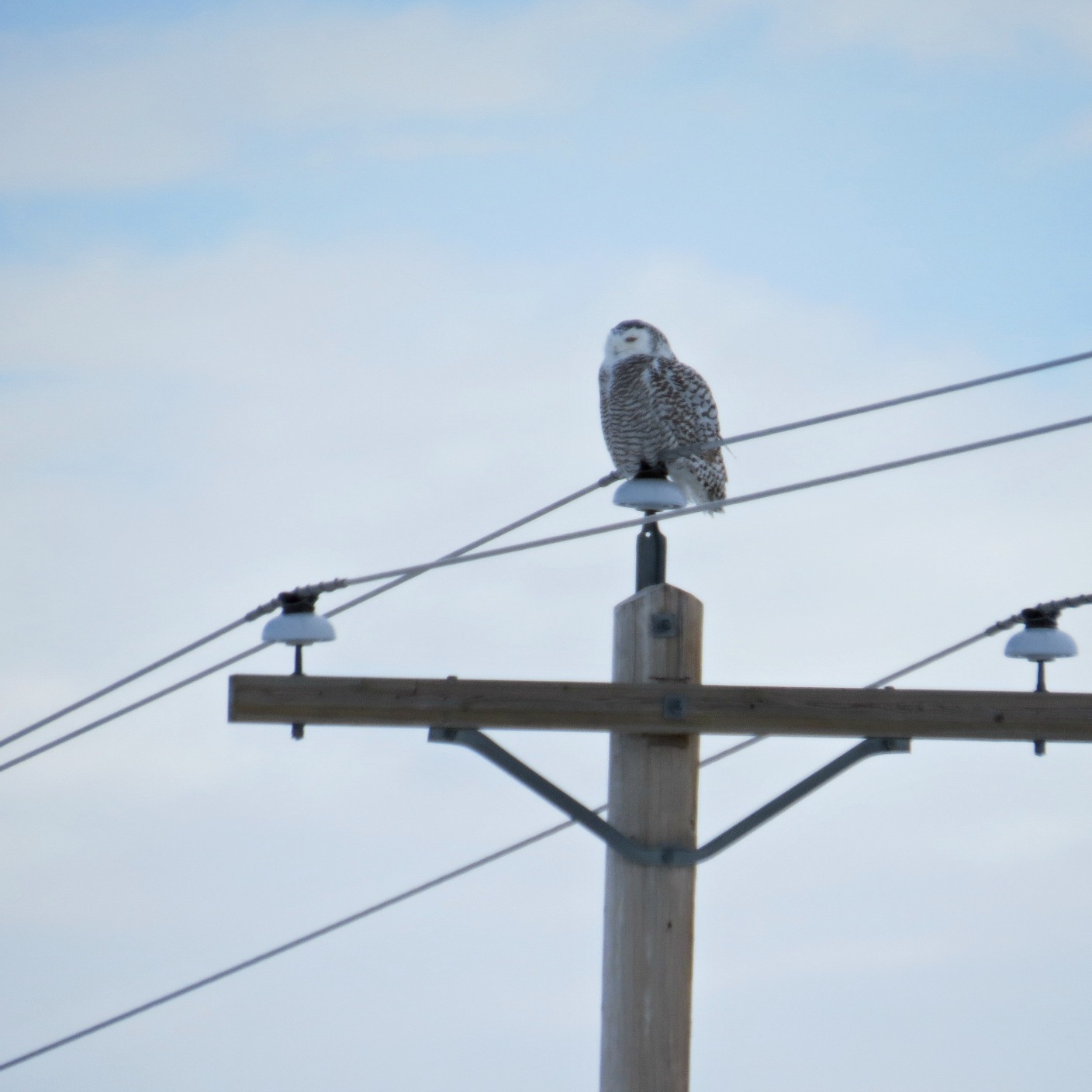
Spectacular Snowy Owls are on the move!

The owls are irrupting well south of their usual winter range in Canada, with reports as far south as Kansas. To read more about the phenomenon in eBird, select this link. If you don’t see a Snowy Owl in your birding ventures, you can still appreciate how truly magnificent these birds are by watching this video from the Cornell Lab of Ornithology.

YouTube Preview Image

Source: Bird Studies Canada

Snow Bath, Anyone?

Tuesday, January 17th, 2012

Posted by Janet Plante

Living in the Boreal Forest is great, but it is even better when we get Chinooks. A Chinook is a warm wind that brings warmer temperatures, often above freezing. We have experienced going from -40 degrees Celsius (-40 Fahrenheit) to 10 above Celsius (50 above Fahrenheit) within 24 hours. The warmer weather allows us to get outside and enjoy the birds. In this picture, taken in January, you can see the water dripping from the tree branches.

This year we are blessed with an abundance of not only the traditional chickadees and common redpolls but pine grosbeaks seem to have taken over our feeders. We have a wonderful chorus and it is great to have more than the usual chick-a-dee-dee-dee.

At times we have counted more than a dozen pine grosbeaks both male and female.

Occasionally we see an evening grosbeak but it seems they have moved on to allow the pine grosbeak cousins a chance at the feeders. There even seems to be a red-breasted nuthatch or two that remains in residence, just to balance off the songbook.

In the middle of December during of one of those Chinooks I was able to watch both the pine grosbeaks and the common redpolls taking a bath in the snow. It was wonderful! They would burrow into the snow and then throw it off. Difficult to take a picture, but great to watch.

You can tell this bird has been having a bath as his feathers look wet. If you look close you can see the water coming down from the spout just in front of this pine grosbeak.

The common redpolls were bathing too. It looked like they were digging a hole in the snow. What fun!

Abstract From The Wilson Journal of Ornithology:

I report a case of snow bathing by House Finches (Carpodacus mexicanus), apparently the first for this species. As many as 15 finches bathed together, three to four at a time, in 18 cm of fresh loose snow in a manner typical when birds bathe in water or dirt: wings fluttered near the sides to spray the snow over the body with back and head plumage erected while the breast was pressed into the snow. Relatively few accounts of birds bathing in snow have been published. I found 23 prior reports of snow bathing for 16 North American species, mostly Passeriformes but including Falconiformes, Galliformes, Strigiformes, and Piciformes. Bathing in loose or uncompacted snow occurred more often than in wet or crusted snow, and there was a tendency for more than one bird to engage in snow bathing during each event. Brevity of accounts prevented identification of other factors that may be frequently associated with snow bathing. Bathing in snow is a routine behavior for some bird species, such as ptarmigan, and European accounts indicate that it is undoubtedly more widespread among North American species than shown by review of the literature.

Paul Hendricks, Montana Natural Heritage Program, Natural Science 205, University of Montana, Missoula, MT 59812, USA


Well, I Know It’s A Hawk

Wednesday, December 7th, 2011

He's not injured, just wearing some of his lunch.

Juvenile raptor identification is a wonderful challenge, isn’t it? What do you think – did I have a Cooper’s Hawk or a Sharp-shinned Hawk in my backyard?

Peruse the photos, make your decision and leave a comment below. It will be interesting to read what folks have to say about my beautiful yard visitor!

Swans of Kimiwan Lake

Thursday, December 1st, 2011

(Guest post by Bob Lefebvre)

On the (Canadian) Thanksgiving weekend in October, I was in Northern Alberta to visit family, and of course to do a little birding on the side.  On October 9th I was driving, along with my brother and brother-in-law, through the town of McLennan, when we noticed that the edges of Kimiwan Lake, the local birding hotspot, appeared to be blanketed in white.  Since it had not yet snowed and the lakes were ice-free, it was apparent that there were a lot of white birds out there.

I thought at first that they might be Snow Geese, but as soon as we got a little closer we could see that they were swans, and there were thousands of them.

Kimiwan Lake is a large, shallow wetland right in the town of McLennan, about 440 km northwest of Edmonton.  It is internationally recognized for its importance to wildlife, particularly waterfowl and shorebirds.

There is an interpretive centre operated by the Kimiwan Lake Naturalists.  A boardwalk winds around some ponds and extends well out into the marsh.  This autumn the water level was low, and when we reached the end of the boardwalk we were still quite far from the main lake.

Below is the view (in the summer) looking out onto the lake from a point near the end of the boardwalk:

Looking back towards the interpretive centre:

On the October day that we were there, the entire edge of the lake was covered with swans, and this is a big lake.  We tried to guess at the number, and came up with (conservatively) at least 10,000.  The true number could be much higher, but it’s difficult to say.  I assumed they were all or mostly Tundra Swans – they were too far away to properly identify (I didn’t have a scope with me), and it was too windy to hear any calls, but I’m not sure there are ever that many Trumpeter Swans in one spot.

As you can see from this next sequence, there were also a lot of geese on the lake, which would occasionally be put to flight by a passing raptor.

There were several Northern Harriers hunting along the shore:

We also saw a few Sandhill Cranes and a pair of Bald Eagles, but I didn’t get photos of those.  I did capture some swans in flight:

At the northeast end of the lake there is a band of golden conifers – possibly indicating damage from the mountain pine beetle, which has been decimating the region:

If you’re ever in this part of Alberta in the spring, summer, or fall, it is well worth stopping off at Kimiwan Lake.

Whoopers in Flight

Wednesday, November 23rd, 2011

Another guest post, this time from Ken Bushman in Saskatchewan, who had the amazing luck to photograph a group of wild whooping cranes in flight. This is not something you see everyday.

I showed this photo to the head of the Whooping Crane Breeding Program at the Calgary Zoo, and he said he’s never seen a photo like this. He suggested they might be a group of juvenile cranes on their first migration. Most whooping cranes travel in small family groups of 3 or 4 birds, so this is really an extraordinary photograph.

Ken says “they were flying about five miles east of Little Manitou Lake, near Watrous where I live. It was pretty cool, I was looking for Mule Deer, it was a very windy day, when I heard them. For some reason they circled above me about three times. By the time I got the camera out, I had about thirty seconds of shooting. I got four or five nice pictures, then they kind of caught the wind and drifted off towards Last Mountain Lake, which is about twenty miles away.”

Finches of the Boreal Forest

Wednesday, November 16th, 2011

No, unfortunately I haven’t been travelling to the boreal forest. This is a guest post from Janet Plante, who lives in the boreal and will be writing monthly blog posts for Bird Canada. Some of the birds she regularly gets on her property throughout the year will make southern bird watchers drool.

We live in a rural area in northwestern Alberta. To the north within a mile or two is a river valley and to the south as far as a bird can fly is boreal forest with very little if any civilization. In fact, if you flew far enough to the west you would end up in the Rocky Mountains.

All year we are entertained by chickadees, woodpeckers, blue jays and nuthatches and for the last year or so we have been blessed with a very large finch family. From the eating frenzy in the winter of the Pine Siskens and Common Redpolls to the occasional and very welcome visits of the Pine Grosbeak we marvel at these colorful birds.

This past summer a flock of Evening Grosbeaks took up residence and we were able to watch the family grow throughout the summer. Observing papa feed a young one almost as big as himself was a real treat.

While the presence of a a Blue Jay would send all of the birds scattering, the Evening Grosbeaks didn’t seem to mind sharing the food and location with their finch cousins, the Purple Finches and the Pine Siskins.

And sometimes we get even more colourful visitors!