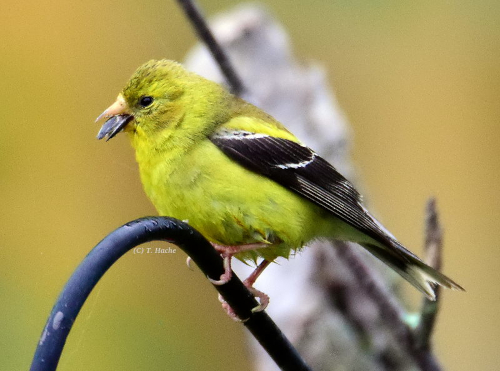
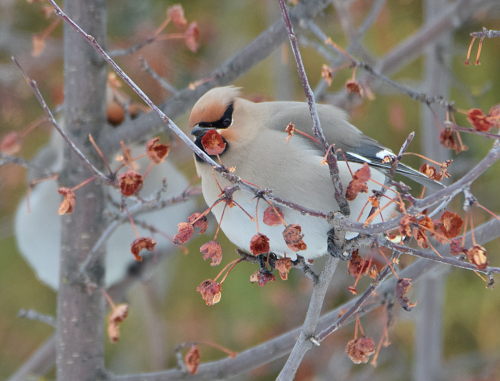
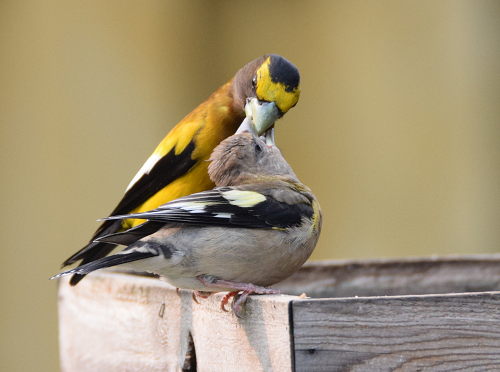
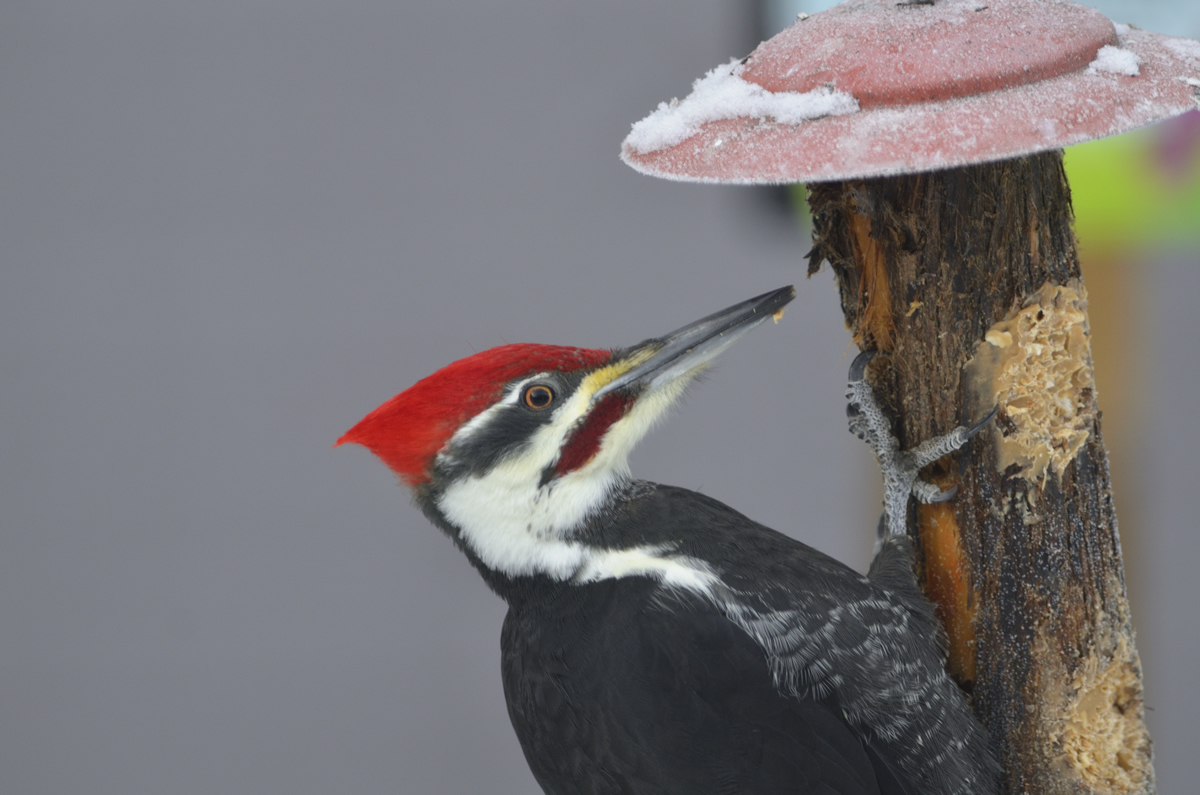
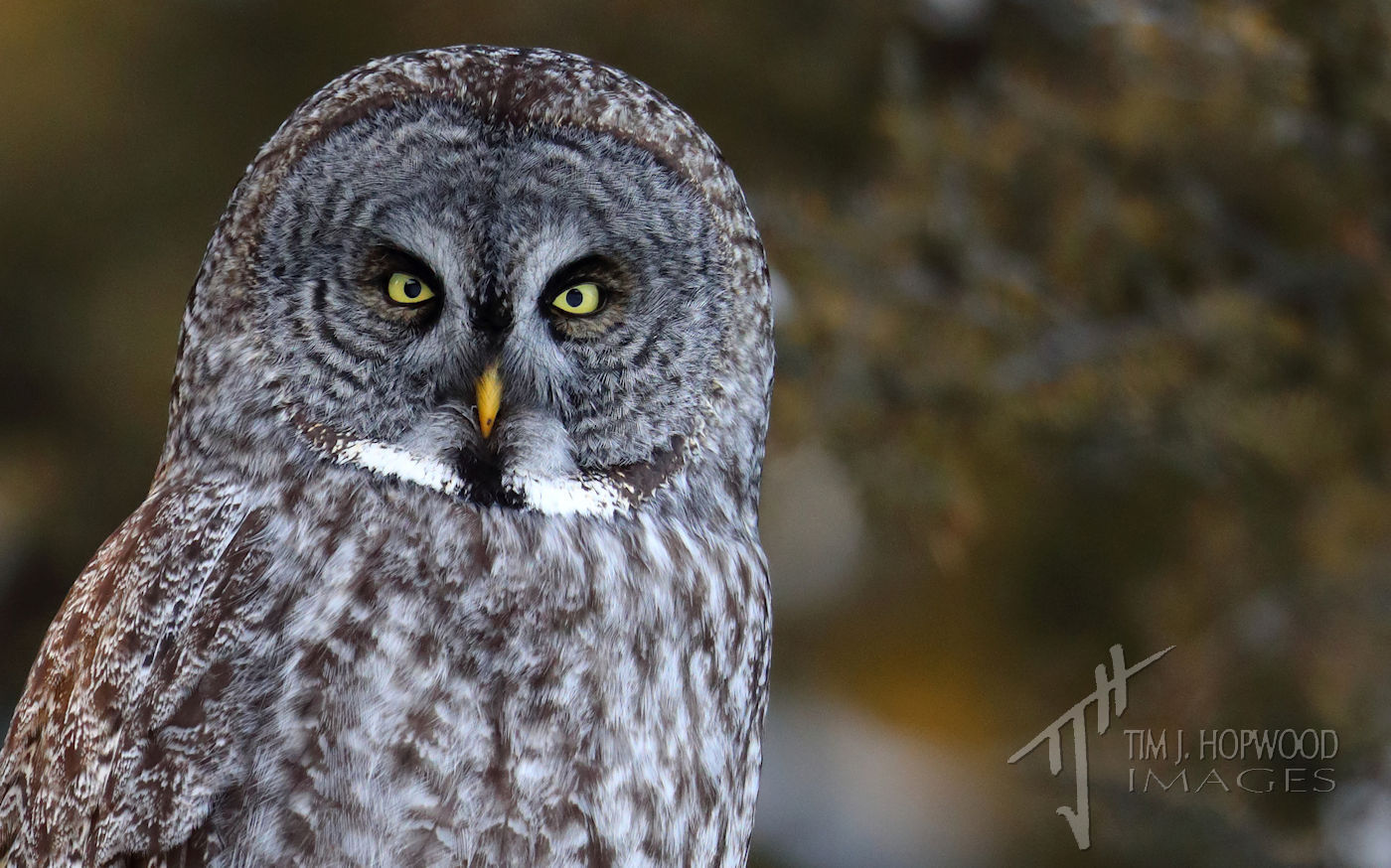
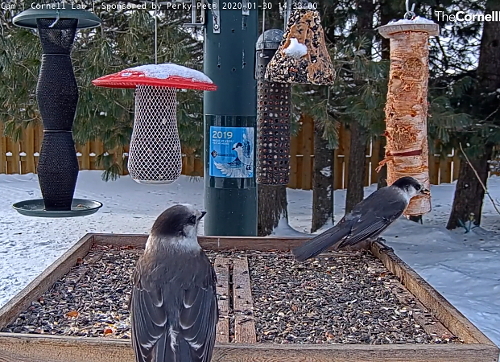
It is a very strange year for birders in this area. Our winter birds are still here, while reports are increasing daily of returning spring visitors.
The weather is ideal, with day after day of sunshine and temperatures around 13C (56F). Staying indoors on Sunday was just impossible, so we headed out for another prairie drive. My goal was to see both a winter and a summer bird in the same day.
The first object of our quest was a snowy owl. There have been few reports of them this year, and their migratory numbers have been very low. I had a tip though, so off we went.
Here is my problem. How many white owls can you see in this picture?

Actually, there are no snowy owls in that picture. I just wanted to give you a feel for what it’s like to look for these birds around here!
We did find one beautiful lady, perched atop a telephone pole in the sunshine.

I even got out of the truck and walked down the road to get closer to her. Nothing says disdain and complete indifference like an owl. That’s why I love owls, they always put me in my place.

She eventually got tired of ignoring me, and soared off across the prairie fields.

That was to be our only snowy owl sighting of the day. But a few minutes after the snowy, we watched this beautiful golden eagle soar overhead for a while.

All the fields held Canada geese, as there is a non-migratory population here. They spend the evenings on the Bow River which doesn’t freeze over, and their days in farmers’ fields.

And where you have masses of Canada geese, you also have the ubiquitous coyotes.

There have been reports of both Red-tailed and Swainson’s hawks in southern Alberta already this spring, and these were the birds I was looking for. Unfortunately, none of these raptors presented themselves to me, even though the Richardson’s ground squirrels are out and about everywhere. My summer birds for the day would turn out to be horned-larks, which were quite abundant on our drive.
So while I didn’t get to see a snowy owl and a Swainson’s hawk on the same day, any birding trip that includes a snowy owl and a golden eagle is a winner with me. We found a new farmer’s market, and took in a few typical prairie scenes on our drive.

For those of you not up on your horse identification, these big guys are Clydesdales, draft horses used to pull heavy wagons in the past.

I love it when grassland farmers leave these buildings standing. Every time I see one, I think about the people who built it, no doubt with hopes of a bright future on the prairies. I wonder if they found it.
Mute swan photo taken Feb 2010 in Florida.
The Mute Swan, a native of Eurasia, was introduced to this continent from the mid-1800s through the early 1900s. Due to their graceful appearance on water, these swans were imported to many areas of North America as an adornment to city parks and large estates. All North American Mute Swan populations originated from the release or escape of individuals from these early captive flocks.
The largest concentration of Mute Swans now occurs along the Atlantic Coast from Maine to South Carolina. Smaller flocks occur in the Great Lakes region and southern British Columbia.
Mute Swans in North America are second in size only to the native Trumpeter Swans. Their wingspan reaches 6.5-7.5 feet (2-2.3 m), and they can weigh up to 32 lbs (14.5 kg).
Called a domestic swan in England, this species is the Royal Swan, an Old World species that has been semi-domesticated in Europe for the last 1000 yrs.
Their population in North America has increased significantly since 1970 and shows few signs of slowing. While these swans are protected in England, their expansion on this continent has begun to pose significant concerns to native wildlife. These birds are aggressive, and have been known to drive off Common loons, Canada geese and Trumpeter swans.
Birds are an important part of the environment in which we live. By monitoring bird distribution and habitat use, we can assess the health of the environments they inhabit (in essence, our environment). The Prairie provinces support hundreds of bird species during the breeding season, and we need to collect data on these species if we are to better understand the changes our environment is undergoing.
In 2008, Bird Studies Canada partnered with the Prairie Habitat Joint Venture and developed the Prairie and Parkland Marsh Monitoring Program (PPMMP) to address information gaps regarding marsh birds.
The PPMMP is currently seeking enthusiastic people with bird identification skills to conduct surveys of wetland-associated birds. The survey targets 10 focal species (including rails, bitterns, and grebes), but many other wetland-associated birds are documented.
Anyone who is interested in wildlife is invited to participate with a project that will benefit efforts to conserve of wetlands and their inhabitants. Participants conduct surveys of marsh birds to collect data that is essential to aiding our understanding of these species and to developing tools that help to guide habitat conservation efforts.

PPMMP participants range from the amateur naturalist to the professional biologist. Although it is not necessary to be an ace-birder to take part in the PPMMP, the marsh bird survey is not suitable for novices. As a general guideline, participants need to be able to identify about 60 species of wetland-associated birds by sight and about half these by sound.
To assist survey preparation, each PPMMP participant receives a training kit that includes:
- Detailed instructions for conducting bird surveys and describing habitat conditions
- A training CD that includes vocalizations of bird species most likely to be encountered in or near marshes
- A broadcast CD that is used during the survey
The training CD is designed to be a useful refresher to fine-tune your skills and provides additional tips for the identification of wetland-associated birds. Included on the training CD is a short recording of a marsh so that participants can test their auditory bird identification skills. A key of species included on the marsh recording will accompany this recording.
What is involved in a Prairie & Parkland Marsh Monitoring Program survey?
PPMMP surveys consist of 15-minute visits to specified locations, referred to as survey stations. During each station visit, all birds that are seen or heard are documented. Survey stations are placed along a survey route; a route may contain as few as three or as many as eight survey stations.
Participants will be responsible for surveying one or more route(s). To survey one route requires a time investment of about 12 hours each year, although folks are encouraged to take on as many routes as they wish.
Survey routes are surveyed three times each year between May 22nd and June 30th. Minimally, surveys at a given station must be conducted at least 4 days apart, although it is ideal to have visits spaced further (8-12 days) apart.
Surveys are conducted in the early morning or in the evening. Favourable weather conditions are preferred for surveying (strong winds and rain should be avoided).
Prairie marshes need your help!
To register or to receive more information, contact:
Prairie & Parkland Marsh Monitoring Program
Bird Studies Canada
115 Perimeter Road
Saskatoon, Saskatchewan, S7N 0X4
Phone: 1-306-249-2894
Email: prairieprograms@birdscanada.org
Website: www.birdscanada.org/volunteer/ppmmp/